
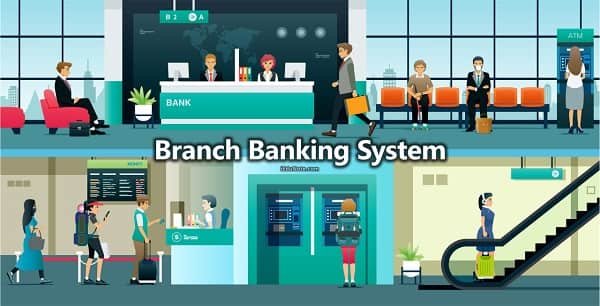
A bank does not become powerful only because of its head office. Its real strength is seen in the branches spread across cities, towns, markets, villages, industrial areas, and residential colonies. A customer may open an account in one branch, withdraw money from another, apply for a loan in a nearby branch, and use the same bank’s services across different locations. This wide network is the heart of branch banking.
Branch banking is a system where one bank operates through multiple branches under a common management. These branches may be located in different areas but they work under the same bank name, rules, policies, technology, and control system. Most large banks in India follow this model.
Branch banking has played a major role in financial inclusion, rural banking, business finance, deposit collection, and customer convenience. But it also has some limitations, such as high operating cost, slow decision-making, and less personal attention in large branches.
What is Branch Banking?
Branch banking is a banking system in which a bank provides services through many branches instead of operating from only one office. The head office controls major policies, while branches serve customers in different areas.
For example, State Bank of India, HDFC Bank, ICICI Bank, Canara Bank, Axis Bank and Bank of Baroda operate through large branch networks. A customer can access banking services from different branches of the same bank, subject to rules and facilities.
Branch banking is different from unit banking, where a bank usually operates from one location or a very small area.
Main Features of Branch Banking
1. Wide Network
Branch banking allows banks to serve customers across different locations. This increases accessibility for individuals, businesses, farmers and institutions.
2. Centralized Control
The head office controls policies, interest rates, loan rules, compliance, risk management and major decisions.
3. Common Brand Identity
All branches work under the same bank name, which builds trust and recognition among customers.
4. Service Availability
Customers can access deposits, withdrawals, loans, cheque services, demand drafts, account updates and other banking facilities through branches.
5. Risk Diversification
Since branches operate in different areas, losses in one region can be balanced by profits in another.
Advantages of Branch Banking
1. Wider Customer Reach
The biggest advantage of branch banking is reach. A bank can serve customers in cities, towns and villages through its branch network. This helps more people access formal banking services.
2. Better Convenience for Customers
Customers do not need to visit only one fixed location. They can use nearby branches for many services. This is helpful for people who move for jobs, studies, business or travel.
3. Supports Financial Inclusion
Branch banking helps banks reach rural and semi-urban areas. It allows farmers, small traders, workers, pensioners and low-income families to enter the formal banking system.
4. Large Deposit Mobilisation
A wide branch network helps banks collect deposits from many areas. These deposits can then be used for lending and investment, supporting economic growth.
5. Better Risk Distribution
In unit banking, the bank depends on one locality. But in branch banking, business is spread across many regions. If one area faces economic problems, other branches may still perform well.
6. Access to More Services
Large branch-based banks usually offer many services such as savings accounts, current accounts, fixed deposits, loans, cards, locker facilities, insurance, mutual funds and digital banking support.
7. Useful for Businesses
Businesses benefit from branch banking because they can deposit cash, receive payments, make transfers and manage accounts across different locations.
8. Stronger Financial Capacity
Branch banks are usually larger institutions with more capital, staff, technology and risk management systems. This helps them provide bigger loans and handle large operations.
Disadvantages of Branch Banking
1. High Operating Cost
Running many branches requires rent, staff, electricity, security, technology, cash management and administrative expenses. These costs can be high.
2. Slow Decision-Making
Since many decisions need approval from regional offices or head office, loan processing and customer requests may take time.
3. Less Personal Relationship
In a large branch banking system, customers may not always get personal attention. Staff transfers and heavy customer load can reduce relationship-based service.
4. More Bureaucracy
Large banking networks often follow fixed rules and procedures. This can make the system less flexible compared to small local banks.
5. Uneven Service Quality
All branches may not offer the same level of service. Some branches may be modern and efficient, while others may be crowded or slow.
6. Risk of Centralized Policy Problems
If the head office makes poor lending or business decisions, the impact can affect many branches together.
7. Staff and Management Pressure
Managing hundreds or thousands of branches is difficult. Monitoring performance, fraud control, customer service and compliance becomes a major challenge.
8. Technology Dependence
Modern branch banking depends heavily on centralized banking software. If systems fail, many branches may face service disruption at the same time.
Branch Banking vs Unit Banking
Branch banking is large, network-based and centrally controlled. Unit banking is small, local and independent.
Branch banking is better for wide reach, stronger financial capacity, large loans and diversified services. Unit banking is better for personal service and local knowledge.
In modern India, branch banking is more common because customers need access to banking services across different locations.
Importance of Branch Banking
Branch banking is important because it connects people with the financial system. It helps customers save money, borrow funds, receive salaries, pay bills, access government schemes and manage business transactions.
Even though digital banking has grown rapidly, physical branches are still important. Many customers still prefer visiting branches for loans, KYC updates, pension issues, account problems, locker services and financial advice.
For rural India and senior citizens, branch banking remains especially valuable.
Conclusion
Branch banking is one of the most widely used banking systems in India and across the world. It allows a bank to operate through multiple branches and serve customers in different areas. Its major advantages include wider reach, customer convenience, financial inclusion, risk distribution and access to more services.
However, it also has disadvantages such as high operating cost, slow decision-making, bureaucracy, uneven service quality and less personal attention.
In simple words, branch banking gives a bank strength through scale and reach, but it must balance size with speed, service quality and customer care.
FAQs on Branch Banking
Q: Why do banks still need branches when digital banking is growing?
A: Branches are still needed for loans, KYC updates, cash services, locker facilities, pension issues, complaints and customers who are not fully comfortable with digital banking.
Q: Can I use any branch of my bank?
A: Yes, many services are available at non-home branches, but some services may still require the home branch depending on bank rules.
Q: Why is loan approval sometimes slow in branch banking?
A: Loan approval may involve document checking, credit assessment, branch recommendation and higher-level approval, which can take time.
Q: Is branch banking better for rural customers?
A: Yes, because physical branches help rural customers access banking services, government schemes, cash transactions and personal support.
Q: Why do service levels differ between branches of the same bank?
A: Service quality may differ due to staff strength, customer load, branch location, local management and digital infrastructure.
Q: Is branch banking costly for banks?
A: Yes, maintaining branches involves staff cost, rent, security, cash handling, electricity and technology expenses.