
Metro rail connectivity has become an important factor in India’s rapidly expanding urban real estate market. As cities grow and commuting distances increase, properties located near reliable public transport can become more attractive to homebuyers, tenants and businesses.
A metro station can improve access to employment hubs, educational institutions, commercial centres and other parts of a city. This improved accessibility can influence housing demand and, in turn, property prices. However, metro connectivity does not automatically guarantee property appreciation. The effect depends on the location, distance from the station, quality of connectivity, surrounding infrastructure, existing property prices and broader market conditions.
Research on transport and real estate generally finds that improved accessibility can become reflected in property values, although the magnitude varies considerably by location and methodology. A review of 136 empirical studies found that transport-related accessibility effects on real estate values have been widely studied, with residential property being the most frequently examined segment.
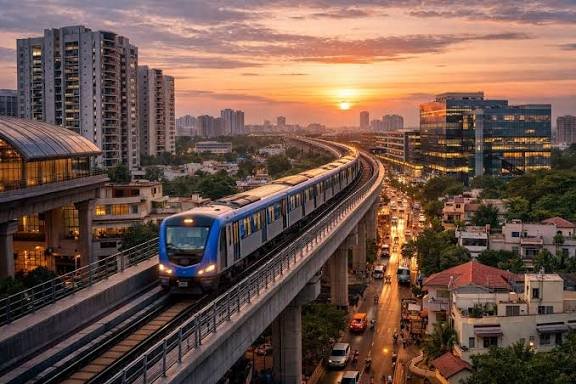
Why Does Metro Connectivity Affect Property Prices?
The basic relationship is relatively straightforward: better connectivity can make a location more accessible.
Suppose two residential areas offer similar apartments, but one is within convenient walking distance of a metro station while the other requires a long road journey to reach public transport. The better-connected area may appeal to people who want to reduce dependence on private vehicles and make daily commuting easier.
As demand increases, sellers and developers may be able to command higher prices, provided that the improvement in accessibility is meaningful and other factors remain favourable.
Metro connectivity can therefore affect property markets through several channels:
- Reduced commuting time
- Improved access to employment centres
- Greater tenant demand
- Better connectivity to other parts of the city
- Increased commercial activity
- Higher development potential around transit corridors
1. Proximity to a Metro Station Matters
Distance from the metro station is one of the most important factors.
A property that is genuinely walkable from a station may receive a stronger accessibility benefit than one several kilometres away.
Delhi’s transit-oriented development framework, for example, identifies different influence zones around mass-transit stations, including areas within 300 metres, 800 metres and 2 kilometres. The National TOD policy also focuses on creating higher-density, mixed-use development around transit stations.
However, “near the metro” should not be interpreted simply as a short distance measured on a map.
A property may be 700 metres from a station in straight-line distance but require a difficult walk because of highways, railway tracks, missing footpaths or poor road crossings. The actual walking route can therefore matter more than the property’s geographical distance.
2. Metro Connectivity Can Increase Residential Demand
A major reason metro connectivity can affect residential prices is its influence on housing demand.
People who commute regularly may value convenient public transport because it can reduce dependence on cars, motorcycles, taxis or other modes of transport.
For example, an employee working in a central business district may consider an apartment farther from the workplace if a direct metro connection provides a predictable commute.
This can increase the number of potential buyers or tenants interested in properties near stations.
The effect can be particularly relevant in large metropolitan areas where road congestion makes long-distance commuting time-consuming.
3. Rental Demand Can Also Increase
Metro connectivity can influence not only sale prices but also rental demand.
Properties near employment centres, universities, hospitals and commercial areas may attract tenants who prioritise public transport.
Potential tenants can include:
- Office employees
- Students
- Young professionals
- Healthcare workers
- Small families
- People without private vehicles
Higher rental demand can potentially reduce vacancy periods and support rental values. However, investors should calculate actual rental yield instead of assuming that proximity to a metro automatically produces high rental returns.
Rental Yield = (Annual Rent ÷ Property Value) × 100
If a metro-connected property is substantially more expensive but rents have not increased proportionately, its rental yield may still be modest.
4. Commercial Property Can Benefit From Footfall
Metro connectivity can also affect commercial real estate.
Retail shops, restaurants, offices and service businesses may benefit from increased pedestrian movement around stations. Areas surrounding major stations can become attractive locations for commercial activity because they provide access to a large pool of commuters.
However, the effect depends heavily on the type of business.
A retail outlet requiring high visibility and pedestrian traffic may benefit from station proximity, whereas a warehouse or low-footfall office operation may value road access, logistics and parking more than direct metro access.
Therefore, the effect of metro connectivity varies between residential, retail, office and industrial property.
5. New Metro Lines Can Influence Future Property Values
Property prices can sometimes respond even before a metro line becomes operational.
When a new corridor is officially planned, buyers and developers may anticipate future improvements in accessibility. This can influence land demand and development activity.
However, buyers should distinguish between:
Announced project → Approved project → Construction → Trial operations → Commercial operations
These stages carry different levels of certainty.
An investor should not pay a substantial premium solely because a broker claims that a metro station is “coming soon.” The project status, approved alignment, station location and implementation timeline should be verified through reliable official sources.
6. Transit-Oriented Development Can Change Land Use
Metro infrastructure can have an effect beyond transportation.
Transit-oriented development, or TOD, seeks to encourage compact, mixed-use development around mass-transit stations. India’s National TOD policy focuses on creating areas where residential, commercial and other uses can be integrated around transit facilities.
NITI Aayog has also discussed TOD as a mechanism for improving access to jobs and services while enabling higher-density development near transit nodes. Its recent policy material notes that land costs account for a significant share of project expenses in metropolitan areas and discusses value-capture mechanisms linked to infrastructure such as metros.
If planning regulations permit additional development around a transit corridor, the resulting increase in development potential can influence land values.
7. Better Connectivity Does Not Always Mean Higher Prices
Metro connectivity is only one factor in determining property prices.
A property may be close to a station but still experience limited price growth because of:
- Poor construction quality
- Legal disputes
- Weak civic infrastructure
- Water or drainage problems
- Excessive traffic or noise
- Poor neighbourhood conditions
- Limited parking
- Oversupply of housing
- High existing property prices
Research also shows that the relationship between transport accessibility and property prices can vary spatially. Studies have found that property characteristics and socioeconomic conditions can remain important determinants of prices alongside transport accessibility.
Therefore, metro proximity should not be used as a standalone investment criterion.
8. Very Close to the Station Can Have Drawbacks
Being close to a metro station can create both advantages and disadvantages.
A property directly beside a busy station may experience:
- Noise
- Heavy pedestrian movement
- Traffic congestion
- Reduced privacy
- Commercial activity
- Air-quality concerns in heavily trafficked areas
For some buyers, being within a short walk of a station may be preferable to living directly beside it.
The ideal distance depends on the neighbourhood, station design, pedestrian infrastructure and individual preferences.
9. Connectivity to Multiple Metro Lines Matters
A property connected to only one station may have fewer transport options than one near an interchange connecting multiple metro corridors.
Interchange stations can provide access to several parts of a city without requiring lengthy road travel.
Consequently, investors should examine not only the nearest station but also:
- Interchange availability
- Number of connected lines
- Feeder buses
- Walking infrastructure
- Last-mile connectivity
- Access to railway stations
- Airport connectivity
- Major employment hubs
A metro station’s usefulness depends on the destinations it actually connects to.
10. Last-Mile Connectivity Is Important
A metro station cannot provide maximum benefit if reaching it is difficult.
Good last-mile infrastructure may include:
- Footpaths
- Pedestrian crossings
- Cycle routes
- Feeder buses
- E-rickshaws
- Auto-rickshaws
- Safe roads
- Parking and drop-off facilities
For example, a property located 800 metres from a station with a safe, continuous pedestrian route may be more practically connected than one located 500 metres away across a major highway.
11. How Buyers Should Evaluate Metro-Linked Property
Before purchasing a property because of metro connectivity, consider the following checklist:
Check the actual distance
Measure walking distance rather than relying only on a property’s advertised distance from the station.
Verify the metro project
For planned corridors, check the official project status rather than relying on promotional claims.
Compare prices
Compare similar properties both near and farther from the station to determine whether the metro premium is already reflected in the asking price.
Study rental demand
Check actual rents and vacancy levels for comparable properties.
Examine surrounding infrastructure
Look at roads, drainage, water supply, schools, hospitals, shops and employment centres.
Calculate total investment returns
Include purchase costs, registration, taxes, maintenance, financing costs, vacancy and expected rent.
Conclusion
Metro connectivity can influence property prices by improving accessibility, reducing commuting difficulties and increasing the attractiveness of nearby residential and commercial locations. Properties with convenient access to metro stations can potentially benefit from stronger buyer and tenant demand, while commercial areas may benefit from increased pedestrian activity.
However, metro connectivity alone does not determine property value. The effect depends on actual walking access, station quality, connectivity to employment hubs, surrounding infrastructure, local supply and demand, existing property prices and broader economic conditions.
India’s TOD policies recognise the relationship between mass transit and urban development by encouraging higher-density and mixed-use development around transit corridors.
For buyers and investors, the practical approach is to treat metro connectivity as one component of a broader property evaluation. Check the actual route to the station, verify proposed infrastructure, compare local prices and rents, examine the property’s legal and physical condition, and calculate the total cost of ownership.
A metro station can make a location more accessible, but the investment value of a property ultimately depends on the combination of connectivity, price, demand, quality, legal clarity and long-term development potential.