
Yes, you can generally get a home loan for an under-construction property in India, provided the borrower meets the lender’s eligibility requirements and the project and property satisfy the lender’s legal and technical checks. Banks and housing finance providers offer loans for eligible under-construction flats and houses, but the way the loan is disbursed differs from a ready-to-move property.
Instead of releasing the entire sanctioned loan amount immediately, lenders generally disburse money in stages based on the construction progress and the payment schedule. The Reserve Bank of India has specifically advised banks that housing-loan disbursements for incomplete or under-construction projects should be closely linked to construction stages rather than being released upfront.
Understanding this process is important because buying an under-construction property involves additional considerations such as construction delays, pre-EMI interest, builder approvals, RERA registration and the possibility of changes to the project.
What Is an Under-Construction Property?
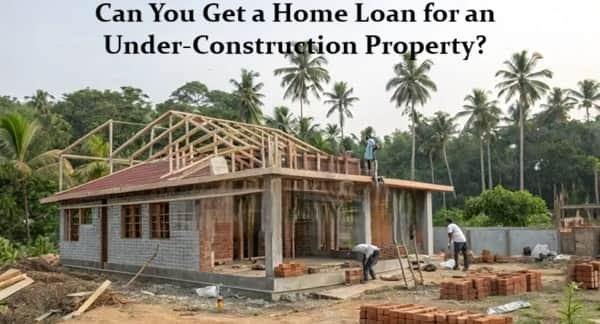
An under-construction property is a residential unit that has not yet been completed and handed over to the buyer. It may be at an early construction stage, midway through development or close to completion.
For example, a developer may launch a project when excavation or foundation work has started. The buyer can book an apartment and make payments according to the construction-linked payment schedule while the building is being developed.
A home loan can be used to finance eligible purchases in such projects. HDFC Bank, for example, explicitly states that its home loans can be used for purchasing under-construction properties from developers, subject to its eligibility and property requirements.
How Does a Home Loan for an Under-Construction Property Work?
The process is broadly divided into two parts: loan sanction and loan disbursement.
First, the lender evaluates the borrower’s income, credit profile, repayment capacity, age, employment or business details and other eligibility factors. It also conducts legal and technical checks on the property.
If the application is approved, the lender sanctions a particular loan amount.
However, the entire amount may not be released immediately. Instead, disbursements are generally made in installments as construction progresses and payment becomes due under the agreement with the developer.
SBI’s published home-loan terms, for example, state that loans can be disbursed in stages where the purchase involves installment payments and that the bank may disburse the amount according to the level of construction of the house or flat.
What Is Stage-Wise Loan Disbursement?
Suppose you purchase an apartment for ₹80 lakh and receive a home-loan sanction of ₹60 lakh.
The bank does not necessarily transfer the entire ₹60 lakh to the builder at the beginning. Instead, the amount can be released in tranches.
A simplified example could look like this:
| Construction Stage | Example Payment | Possible Loan Disbursement |
| Foundation | ₹10 lakh | Based on eligible stage |
| Structure | ₹15 lakh | Based on progress |
| Brickwork/finishing | ₹20 lakh | Based on progress |
| Final stages | ₹15 lakh | Based on completion/payment requirements |
The exact percentages and timing depend on the builder’s payment schedule, lender’s policy and project status.
The purpose of stage-linked disbursement is to reduce the risks associated with releasing a large amount of money before the property has been substantially constructed. RBI guidance specifically addresses this issue and discourages upfront disbursement for incomplete or under-construction projects.
What Is Pre-EMI Interest?
One of the most important concepts for an under-construction home loan is pre-EMI.
After the first portion of the loan is disbursed, the borrower may have to pay interest on the amount actually disbursed rather than immediately paying the full principal-and-interest EMI on the entire sanctioned amount.
For example, suppose:
- Total sanctioned loan = ₹60 lakh
- Amount disbursed initially = ₹15 lakh
- Remaining sanctioned amount = ₹45 lakh
During the initial period, interest may be calculated on the ₹15 lakh already disbursed. As additional amounts are released, the interest obligation increases.
HDFC Bank describes a tranche-based repayment facility under which buyers of under-construction property generally service interest on the amount drawn until final disbursement, after which regular EMI repayment applies. It also states that borrowers may have an option to begin principal repayment earlier under the applicable facility.
The exact repayment structure should therefore be confirmed with the lender before signing the loan agreement.
Pre-EMI vs Full EMI
The difference can be understood simply:
Pre-EMI:
You generally pay interest on the amount already disbursed.
Full EMI:
You pay both principal and interest according to the repayment schedule.
Suppose your loan is sanctioned for ₹60 lakh but only ₹20 lakh has been disbursed. Under a pre-EMI structure, interest is generally calculated on the ₹20 lakh actually drawn, not automatically on the entire ₹60 lakh.
Once the full loan is disbursed, regular EMI payments can begin according to the loan terms.
However, borrowers should understand that pre-EMI payments generally do not reduce the principal in the same way as a regular EMI containing both interest and principal.
What Documents Are Required?
The lender normally requires documents relating to both the borrower and the property.
Common borrower documents include:
- PAN or applicable identity documents
- Address proof
- Income proof
- Salary slips for salaried applicants
- Bank statements
- Income-tax documents where applicable
- Employment or business documents
- Photographs
- Details of existing loans
Property-related documents can include:
- Booking/application documents
- Agreement for sale
- Allotment letter
- Builder-buyer agreement
- Approved building plans
- Project approvals
- RERA registration details, where applicable
- Payment schedule
- Title-related documents
- Demand letters from the developer
Lenders may request additional documents depending on the project and borrower.
HDFC Bank’s home-loan documentation requirements include identity, residence, income and property-related documents, while its loan agreement also specifies submission of approved sanctioned plans as a condition relevant to disbursement.
What Should You Check Before Taking the Loan?
Getting loan approval does not mean that the buyer should skip independent property due diligence.
Before committing to an under-construction project, check:
1. RERA Registration
Where RERA applies, verify the project on the relevant state RERA portal.
The Real Estate (Regulation and Development) Act, 2016 gives an allottee the right to obtain information concerning sanctioned plans, layout plans and project specifications.
2. Builder’s Title and Approvals
Check whether the developer has the necessary rights over the land and whether required approvals have been obtained.
3. Agreement for Sale
Read the agreement carefully before making substantial payments.
Under Section 13 of RERA, a promoter generally cannot accept more than 10% of the cost of an apartment, plot or building as an advance or application fee without first entering into and registering an agreement for sale. The agreement must contain specified project and payment details.
4. Construction-Linked Payment Plan
Understand exactly when each installment becomes payable and whether the lender’s disbursement schedule matches the developer’s demands.
5. Possession Timeline
Check the contractual possession date and the consequences of delay.
What Happens If the Project Is Delayed?
Construction delay is one of the major risks associated with an under-construction property.
The buyer may have to continue servicing the amount already disbursed even though the apartment is not ready for possession. If rent is also being paid for current accommodation, the household may face both housing expenses and loan-related payments.
RBI has specifically identified project non-completion and disputes between borrowers and developers as risks associated with certain housing-loan structures.
Therefore, buyers should maintain sufficient financial reserves rather than assuming that the project will always be completed exactly on schedule.
Is a Home Loan Sanction the Same as Disbursement?
No.
Loan sanction means the lender has approved a specified loan amount subject to the terms and conditions of the sanction.
Disbursement means the lender actually releases part or all of the approved amount.
A sanctioned loan may not be fully disbursed until the required documents, construction stage, payment demand, legal conditions and other requirements are satisfied.
SBI’s published terms, for example, state that disbursement is subject to prescribed documentation, mortgage/security requirements and applicable statutory compliances.
Can You Get a Loan for Every Under-Construction Property?
Not necessarily.
A lender can reject or restrict financing if the project or property does not satisfy its legal, technical, documentation or risk requirements. The borrower’s income, credit history, existing obligations and repayment capacity also affect eligibility.
Some lenders maintain lists of approved projects or developers, but being associated with a lender does not eliminate the need for the buyer to conduct independent due diligence.
Conclusion
You can get a home loan for an under-construction property in India, provided both the borrower and property meet the lender’s requirements. The major difference from a ready property is that the loan is generally disbursed in stages according to construction progress and applicable payment requirements.
Buyers should understand the difference between loan sanction and disbursement, calculate the effect of pre-EMI, examine the builder’s payment schedule and verify the project’s legal and regulatory status.
RERA provides important protections and gives allottees rights concerning sanctioned plans, project information and possession-related matters. At the same time, buyers should independently review the title, approvals, agreement for sale and construction timeline.
An under-construction property can therefore be financed through a home loan, but the decision should be based on more than loan eligibility. Understanding the disbursement schedule, repayment structure, project documentation and potential construction delays can help a buyer plan the purchase and borrowing more effectively.